
Oct 2026 Humanitarian Safari Group Page
With Special Guest: Adassa
Travel Tabs
Your Itinerary
Group Notes
Video Meetings
This page is meant for travelers who have registered to go with Hearts and Hands for Humanity on a Humanitarian Safari. If you have not yet registered you can learn more about the trip here.
Sample Tabs
The following tabs are samples that we share with all travelers. As we plan the trip you will see more specific information about your group and itinerary farther below.
For more details on lodging and each of the activities on the intinerary, see the Humanitarian Safari page and click on “learn more” for each item.
- Sample Itinerary
- Packing List
- Travel Documents
- Money
- Helpful Swahili Phrases
- WhatsApp & Zoom
- Days For Girls Training
- 7-Day Hike Info (Interary, Packing)
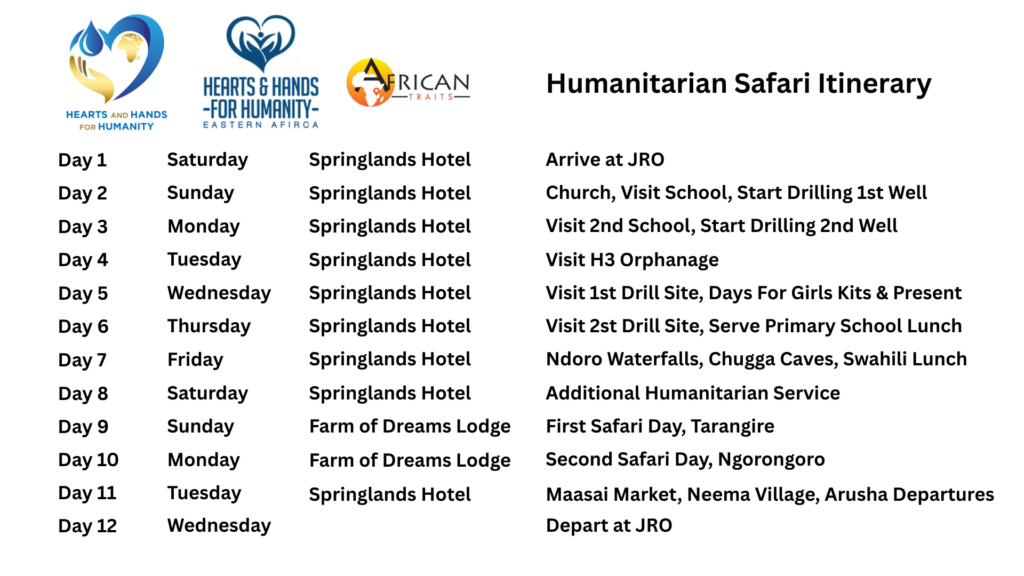
Keep in mind that this is Africa. You can wear the same clothes for more than one day before washing them. The hotels will do laundry (very affordably) or you may bring single packs of Tide laundry soap to wash your clothes if you wish.
Check with your airline. You may be allowed two free checked bags, up to 50 pounds each, plus a carry-on and personal item. With smart packing you'll only need one bag, but we can fill the rest with donations for the humanitarian services. After the humanitarian donations have been distributed that then leaves space for souveniers.
Items to pack:
- Passport and immunization report
- Money, best in crisp, new $100s - you may exchange money at the JRO airport for shillings for souvenirs and any extra things while in Tanzania. See also Money tab.
- 2-3 pants or shorts, lightweight, quick-dry for all weather and easy wash (100% nylon or a nylon/spandex blend, "hiking" convertible pants are suggested but not required)
- 2-3 shirts, lightweight, quick-dry, with UPF sun protection for all weather and easy wash
- 4-11 pair of underwear (depending on if you plan to do laundry)
- 4-11 pair of socks (depending on if you plan to do laundry, Merino Wool socks are suggested but not required)
- Water-resistant jacket or raincoat
- Sunglasses and Hat
- A pair of multi-use shoes (hiking, working, playing, church)
- Swimsuit for the pool at the hotel, the safari lodge, and the waterfall.
- Water shoes or strap-on water-resistant sandals for the waterfall (and some hiking down to the waterfall, water shoes or sandals are fine for this hike or you can change shoes between hiking and getting in the water if desired)
- Toiletries: toothbrush, toothpaste, shaving, travel-size shampoo, etc. Follow flight regulations for aerosols, liqids, gels, creams
- Sunscreen and sunburn spray
- Mosquito repellent or wristbands
- Medications, including medication for malaria
- Wet wipes, hand sanitizer, and a roll of toilet paper (travel size 😊)
- Tide single packs to wash clothes
- Snacks, electrolyte water mix packs
- Neck pillow for flights
- Headphones, phone, camera, any small electronics, portable chargers
- Electric CONVERTER (not an Adapater, which is different, should support 120V to 240V conversion and also acts as an adapter for type G outlets if only traveling in Tanzania, and possibly type D and E/F if traveling outside of Tanzania)
- Black trash bag, gallon zip-lock or hamper bags for dirty clothes that you don’t plan on washing
- Day bag or backpack
- Washcloths
- Binoculars for the safari
If attending church:
- White shirt and tie (men), (your choice if you bring extra slacks and nicer shoes, but most travelers wear their gray or tan hiking pants and hiking/work boots)
- Dress (women), (your choice if you bring seperate shoes, though a smart pair of sandals can be used for both water activities and church)
Filling the extra space:
- Candy for the village and school kids
- Frisbee and soccer balls for kids in the villages
- Humanitarian donations that you'd like to donate or which we provide for you to bring prior to travel if we can get it to you. (Could be school supplies, blankets, computers; there will be some group requests)
Expert tip: Manual, no-motor vacuum travel bags can help maximize use of luggage space and even keep clean clothes seperate from dirty ones.
There are places to buy things like snacks and toiletries if needed; you don't have to pack for armegeddon. You do not have to buy mosquito nets, the hotels have them. You could bring tape in case the nets have minor holes. You do not have to pack water except for the plane ride; we will provide water and drinks during the trip. You can also buy larger water bottles at the hotel. The buses have coolers to keep water and drinks cool.
Passport (with additional 6 months’ validity after proposed expedition return date)
Tanzanian Entry Visa. (If flying to Nairobi and taking the bus to Arusha, Kenyan visas can be bought on arrival at Nairobi airport.)
Air Travel Documents
Credit Card (recommended for eventualities only)
Travel Insurance Documents
Vaccination Certificates (Yellow Fever, if visiting a ‘risk zone’ prior to entering Tanzania)
Traveller’s Cheques are not recommend as they are subject to very poor conversion rates in Moshi or Arusha.
Planning the trip
Plan for the following trip expenses beyond the package pricing:
- Airfaire is estimated to be $1,500 to $1,800 per person, less if you're able to scout for deals or use flyer miles
- Any new gear for the trip
- Passport fees and vaccinations
- Tanzania Visa, $100 per person
- Tipping service staff at hotels and lodges
- Tipping the guide for Ndoro Waterfalls hike
- Tipping the guides and porters at Mt Kilimanjaro for either the 1-Day or 7-Day Hike
- Tipping your Safari Driver
- Tipping group bus drivers
- Any souvenirs purchased during the trip.
- Kenya Visa or other Visas
While on the trip:
The Humanitarian Safari includes all food and lodging. However, you will want to bring cash for flight layovers, Visas, snacks, souvenirs, emergencies, and tips.
Only a few places will take your debit or credit cards. We recommend you bring cash for everything you expect to spend money on. You can withdraw up to about $175 daily from an ATM in emergencies.
Get the best conversion rate by bringing new, crisp $100 bills. Please make sure they are newer than 2009. Lower denominations of $1, $5, $10 and $20 can be used for tips, but tips can also be in local currency.
Money conversion rates will vary, but typically, you can expect to get around 2,600 Tanzanian Shillings for $1 USD. That means for every $100 you exchange, you will receive TSH 260,000. The best place to exchange money is at the airport. We can make other opporutunities to exchange money if needed.
Tanzania Visa—You will acquire your visa at the airport as you pass through customs. The cost is $100 per person when you tell them you are in the country for a safari.
All tips are NOT included with the Humanitarian Safari package. You'll need tips for your safari drivers, group bus drivers, hiking guides, hotel service professionals and possibly others. We will discuss suggested amounts for tips during planning meetings.
If you want to consume alcoholic beverages, you will need to purchase them on your own, as they are not included in the trip's cost.
Swahili pronounces every vowel and even pronounces some consonants as if they had vowels but without vowels between them.
For example:
- Asante is pronounced ah-san-tay
- Ngorongoro is pronouned en-gor-on-gor-oh (the "r"s are slightly rolled, but not as much as Spanish)
- Ndoro is pronounced en-dor-oh
- Tarangire is pronounced tah-ran-gee-ray (with the "r" slightly rolled)
Keep that in mind as you learn this list:
Asante - Thank you
Asante sana - Thank you very much
Hakuna matata - No worries (yep, the phrase from The Lion King is a real thing, and they say it often)
Tafadhali - Please
Hujambo - How are you? or Hello
Sijambo - Doing good or doing fine.
Jambo - The way tourists say Hujambo.
Mambo - What's up?
Poa (Pronounced Po-ah) - Cool or "its all good". Common reply to Mambo
Shikamoo - I respect you (Essential, formal expression for elders and those in authority)
Marahaba - I accept your respect
Karibu - Welcome, "come in" or "you're welcome".
Bei gani? - What is the price? (though if you're going to haggle, do it in English)
Hapana (ha-pah-na) - No
Hapana, sante - No, thank you
Choo kiko wapi? - Where is the bathroom
Wapi choo? - Where is the bathroom (less formal)
Nakupenda - I love you (can be interpreted in a romantic way, so be careful)
Nakupenda pia - I love you too
Kaka - Brother (not a toilet joke, even if you know Spanish)
Dada - Sister (confusing, right?)
Nakupenda kaka yangu - I love you my brother
Nakupenda dada yangu - I love you my sister
Nawapenda - I love you all
Napenda Tanzania - I like/love Tanzania
Napenda chakula hiki - I like/love this food
Rafiki yangu - my friend
We use WhatsApp for group communication because it's something easy that everyone in the group can adopt, it's secure with encryption, and it works well for international communications. This means that we can use it even while we're in Africa and our African teams can also join the group communication.
Download WhatsApp:
- Android: Google Play Store
- Iphone: Apple App Store
- Desktop App: Whatsapp For Windows
- Desktop App: Whatsapp for Mac
- Browser (Online): Whatsapp Web App
Group video meetings are conducted and recorded using Zoom. The recordings are posted on your group planning page.
Travelers who are planning to give the presentation when we distribute Days For Girls Kits and reusable mentrual cups can take the training provided by Days For Girls prior to travel.
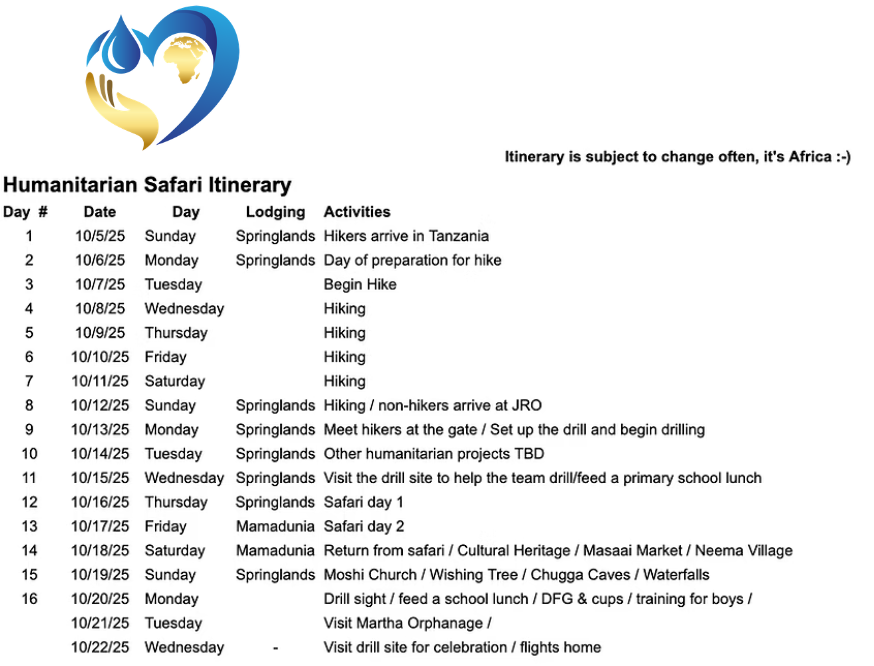
7-Day Hike Description:
DAY 1 Forest Camp to Shira Camp 1. We continue on the trail leading out of the forest and into a savannah of tall grasses, heather, and volcanic rock draped with lichen beards. As we ascend through the lush rolling hills and cross several streams, we reach the Shira Ridge before dropping gently down to Shira 1 camp. The view of Kibo from across the plateau is amazing.
DAY 2 Shira Camp 1 to Shira 2 to Moir Hut. We explore the Shira plateau for a full day. It is a gentle walk east toward Kibo's glaciered peak, across the plateau which leads to Shira 2 camp on moorland meadows by a stream. Then we continue to Moir Hut, a little used site on the base of Lent Hills. A variety of walks are available on Lent Hills making this an excellent acclimatization opportunity. Shira is one of the highest plateaus on earth.
DAY 3 Moir Hut to Lava Tower to Barranco Camp. From the Shira Plateau, we continue to the east up a ridge, passing the junction towards the peak of Kibo. As we continue, our direction changes to the South East towards the Lava Tower, called the "Shark's Tooth." Shortly after the tower, we come to the second junction which brings us up to the Arrow Glacier at an altitude of 16,000ft. We now continue down to the Barranco Hut at an altitude of 13,000ft. Here we rest, enjoy dinner, and overnight. Although you end the day at the same elevation as when you started, this day is very important for acclimatization and will help your body prepare for summit day.
DAY 4 Barranco Camp to Karanga. After breakfast, we leave Barranco and continue on a steep ridge pass-ing the Barranco Wall, to the Karanga Valley campsite. This is a short day meant for acclimatization.
DAY 5 Karanga Camp to Barafu Camp. After breakfast, we leave Karanga and hit the junction which connects with the Mweka Trail. We continue up to the Barafu Hut. At this point, you have completed the South Circuit, which offers views of the summit from many different angles. Here we make camp, rest, enjoy dinner, and prepare for the summit day. The two peaks of Mawenzi and Kibo are to be seen from this position.
DAY 6 Barafu Camp to Summit to Mweka Hut. Very early in the morning (midnight to 2am), we continue our way to the summit between the Rebmann and Ratzel glaciers. You head in a northwesterly direction and ascend through heavy scree towards Stella Point on the crater rim. This is the most mentally and physically challenging portion of the trek. At Stella Point (18,600 ft), you will stop for a short rest and will be rewarded with the most magnificent sunrise you are ever likely to see (weather permitting). From Stella Point, you may encounter snow all they way on your 1-hour ascent to the summit. At Uhuru Peak, you have reached the highest point on Mount Kilimanjaro and the continent of Africa. Faster hikers will see the sunrise from the summit. From the summit, we now make our descent continuing straight down to the Mweka Hut camp site, stopping at Barafu for lunch. You will want gaiters and trekking poles for the loose gravel going down. Mweka Camp is situated in the upper forest and mist or rain can be expected in the late afternoon. Later in the evening, we enjoy our last dinner on the mountain and a well-earned sleep.
DAY 7 Mweka Camp to Moshi. After breakfast, we continue the descent down to the Mweka Park Gate to receive your summit certificates. At lower elevations, it can be wet and muddy. Gaiters and trekking poles will help. Shorts and t-shirts will probably be plenty to wear (keep rain gear and warmer clothing handy). A vehicle will meet you at Mweka village to drive you back to Moshi.
7-Day Hike Packing List
BAGGAGE AND SLEEPING KIT FOR CLIMBING KILIMANJARO:
- Large Rucksack or Holdall, 70-90 litres capacity (for kit carried by porter)
- Daysack, 25-35 litres (for personal use on mountain; ready-access items)
- Sleeping Bag (minus 10 degrees Centigrade rating or colder).
- Waterproof rucksack liner or heavy duty plastic sack
- Elasticated waterproof rucksack cover
NOTE: Sleeping mattresses are not required as we provide these for you. We can also provide the sleeping bag if desired.
CLOTHING FOR CLIMBING KILIMANJARO:
- Sweat-wicking T-shirts / vests
- Fleece.
- Insulated down jacket or similar.
- Down mittens or similar.
- Thermal long-johns for summit night.
- Lightweight walking trousers (avoid jeans or heavy cotton as they chafe and dry slowly)
- Underwear (briefs are usually better than boxer shorts which gather and chafe)
- Very good quality hiking socks and thin-liner socks. (We advise that socks should be at least a size too small otherwise they stretch and bunch causing blisters)
- Breathable lightweight waterproofs (jacket and trousers).
- Waterproof walking boots, sturdy and worn-in. A Gore-Tex membrane or similar is advised. While Alpine or C3 boots are not required for Kilimanjaro it is important that your boots have good ankle and arch support and good deep read patterns.
- Calf gaiters
- Balaclava
- Walking Poles
- Goretex Mountain Cap or Woollen Hat
- Wide brimmed sun hat to protect face, ears and neck
HYGIENE-RELATED GEAR FOR USE ON KILIMANJARO:
- Toothbrush, toothpaste & deodorant
- Flat packed Wet Ones, travel wipes, or similar for personal hygiene on the mountain.
- Kleenex tissues in plastic travel pouches or toilet paper
- Hairbrush / comb
- Sanitary products
- Lip salve with UV protection
- Vaseline, to prevent chafing skin and heel friction blisters
HEALTH-RELATED ITEMS FOR KILIMANJARO:
- Malaria Tablets (if you choose to take these. Most will seek advice from their GP. Note that some anti-malarial courses need to commence several weeks before departure)
- Factor 30+ sun cream
- Sun barrier cream white / blue for nose and ears
PERSONAL SMALL FIRST AID KIT TO BE CARRIED BY EACH CLIMBER ON KILIMANJARO:
- Pain Killers (Ibuprofen)
- Diamox (Acetazolamide) if you choose to use this.
- Paracetamol
- Zinc oxide tape and small scissors.
- Compeed Blister Pads
- Loperamide Diahorrea Tablets
- Any medication you normally use
- Dioralyte sachets or similar rehydration packs.
NOTE: Your guide will carry a more comprehensive medical kit containing additional Acetazolamide, Ibuprofen, Anti-inflammatory gel, bandages, Loperamide, Amoxycilin, Oral Dexamethasone, and several other items.
Where a climber has specific health concerns that they or their doctor anticipate being exacerbated by exposure to high altitude, or if he has a history of heart disease in the family, we would advise that he requests that we carry an additional canister of emergency oxygen.
OPTIONAL BUT RECOMMENDED:
- Mountain Fuel (inter-meal energy supplements and recovery drinks)
- Camera and film or Digital Camera and spare memory cards
- Sunglasses with UV-filter lenses
- Gaiters
- High energy snacks (Cereal bars, dried fruit and nuts)
- Spare Contact Lenses and fluid, if worn
- Watch
- Head torch with spare batteries and bulb for summit night & tent admin
- Water bottles & Camelbak (3 litres carrying capacity)
OPTIONAL BUT RECOMMENDED:
- Nuun hydration aids (portable electrolyte replacement tablets)
- Water Purification Tablets / Iodine drops although we have them
- Ear Plugs and blindfold (to aid sleep on afternoon before summit night)
- Plastic bags (for dirty washing, wrappings, etc.)
- Telescopic walking poles (optional)
- Mobile phone. There is signal reception on most parts of the mountain. It is a good idea to unlock your phone before you come out so that a local sim card can be used.
OPTIONAL BUT RECOMMENDED:
A good, strong, thermally efficient blizzard survival bag. We strongly recommend that all climbers possess one of these, especially when training alone or in small groups while preparing for Kilimanjaro. On Kilimanjaro, perhaps 10 – 15% of climbers complain to their guides of being cold in their sleeping bags, despite using a bag that is rated for minus 20 degrees C or lower. This is because the body generates less heat when there is relatively little oxygen available. Having one of these bags will reflect much of that precious heat back to where it’s needed.
Note: We do have rental store in Moshi with all the gear needed for Kilimanjaro hiking. If there is gear that you don’t have and you may want to rent there before going to the mountain then send Alan a list!
Your Itinerary
This is the actual itinerary for your group:
We will post your itinerary here when it becomes available.
For more details on lodging and each of the activities on the intinerary, see the Humanitarian Safari page and click on “learn more” for each item.
Group Notes
This Humanitarian Safari will include a very special guest, Adassa, who is a world-renowned singer and songwriter, and the voice for Dolores in Disney’s Encanto. Adassa has been a wonderful partner with Hearts and Hands for Humanity (H3) and is a frequent performer at H3 events, such as the annual Gala.
We encourage everyone to enjoy the trip as a peer-to-peer gathering. To keep the atmosphere relaxed and authentic, we ask that all participants treat the group dynamic as a private, social setting. There may be specific rules regarding photography and posting to social media.
Our team will be capturing select moments throughout the journey to create marketing content for the organization. There may be times when our team requests a brief pause in guest photography to ensure we capture the necessary footage for H3 collateral. We appreciate your patience and cooperation during these moments as it helps us showcase the impact of this trip to the broader community.
Video Meetings
All video meetings for planning your trip will be posted here for reference. All video meetings are conducted using Zoom.